From 'Alexa, Find a Full-Bodied Red Under $20' to 'Hey Google, What Pairs With Salmon?': How Voice Search Is Reshaping Liquor Store Product Discovery
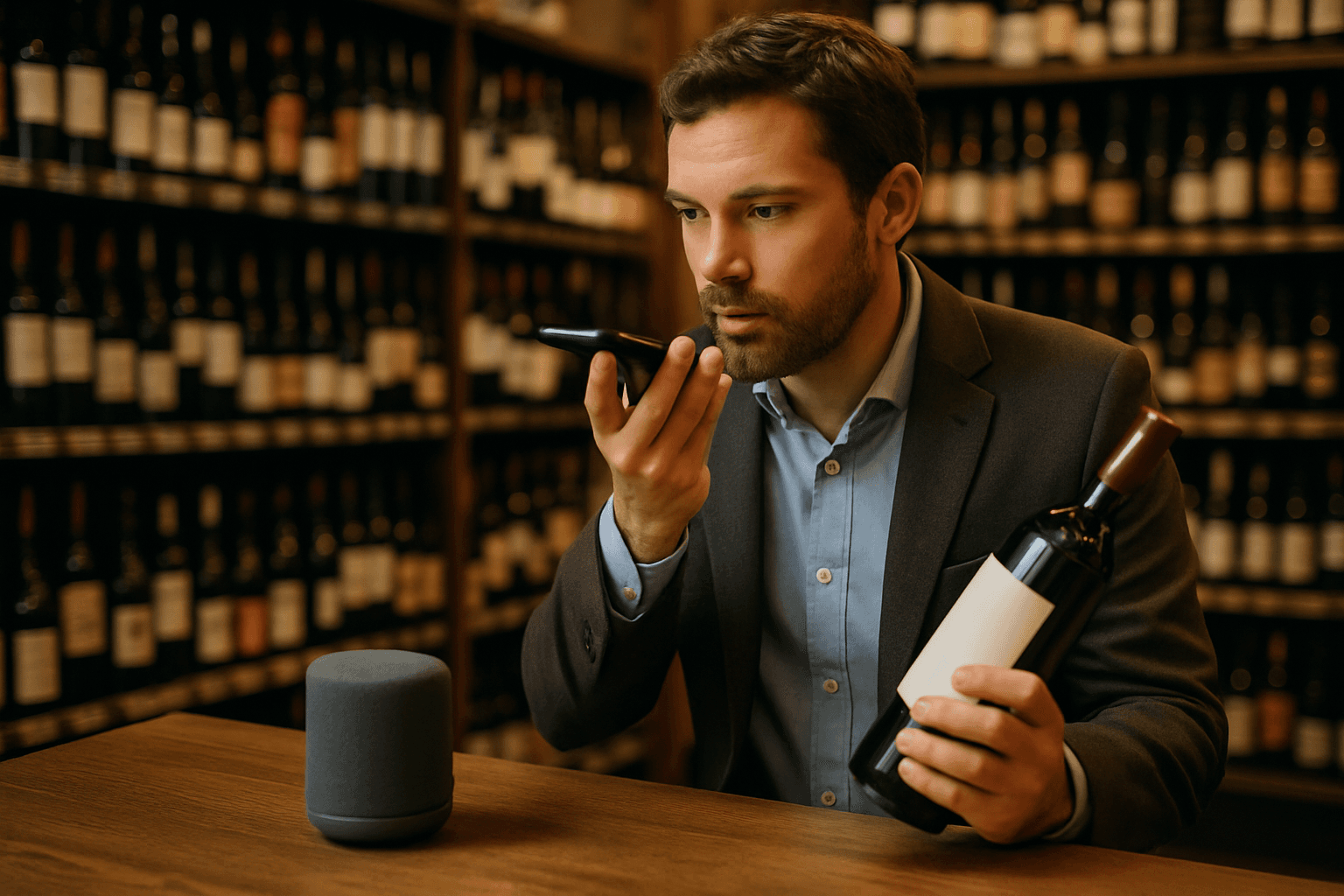
Voice search is changing how customers find alcohol products. Learn how liquor stores can leverage AI and voice commerce to stay competitive.
- The Voice-First Future Is Already at Your Door
- Understanding Voice Search: The Simple Version
- The Numbers Don't Lie: Voice Search Adoption in Retail
- How Smart Speakers Are Becoming Your Silent Sales Associate
- Voice Apps in the Wine & Spirits Industry: Leading by Example
Picture this: It's 6 PM on a Tuesday. You're standing in your kitchen, salmon thawing in the sink, and you shout across the room, "Hey Google, what wine pairs with salmon?" Your smart speaker responds instantly with a recommendation, a price point, and even a nearby store that carries it. Without stepping foot outside, you've just completed a purchase decision.
Now imagine you're the owner of that nearby store. Did your inventory show up in that conversation? Or did a national retailer with deeper digital roots capture that sale while you were none the wiser?
This isn't a glimpse into some distant sci-fi future, it's happening in homes across America right now, multiple times a day. Voice search is fundamentally changing how customers discover alcohol products, and for neighborhood liquor stores, this shift represents both an urgent challenge and an untapped opportunity.
The good news? You don't need a computer science degree to understand what's happening or to start positioning your store for success in this voice-first world. Let's break it down.
The Voice-First Future Is Already at Your Door
The scenario above isn't hypothetical, it's the new normal. Smart speakers have become trusted advisors in millions of households, handling everything from recipe questions to product recommendations with increasing sophistication.
Why customers are talking to their devices instead of searching
Think about how you behave online versus how you ask questions out loud. When typing, customers search with fragments: "red wine under $20." When speaking, they ask full questions: "find me a smooth red wine that goes with pasta for under twenty dollars."
This difference is the foundation of voice commerce alcohol. Customers still want the same things, recommendations, pairing advice, budget-friendly options, but they're expressing those needs in a more conversational, natural way. Many consumers now use voice search to research products before making a purchase decision, and this behavior is rapidly spilling into alcohol purchasing, where shoppers ask their devices about wine pairings, cocktail recipes, and brand recommendations.
What this means for neighborhood liquor stores
Here's the uncomfortable truth: if your store isn't visible in these voice-driven discovery moments, you risk becoming invisible during the most critical phase, when customers are actually deciding what to buy.
Agentic commerce is beginning to transform how alcohol retail handles product discovery, and stores that adapt now will capture these conversations before someone else does. The question isn't whether voice search will impact your business, it's whether you'll be part of the conversation when customers are ready to buy.
Understanding Voice Search: The Simple Version
The technology behind voice search can feel overwhelming, but at its core, it's actually quite straightforward. Think of it like having a knowledgeable friend working behind your counter, one who knows every bottle on your shelves and can instantly match customers to exactly what they need.
How Voice Search Differs from Text Search
The difference between text and voice search comes down to how people naturally communicate. When typing, customers search with fragments: "red wine under $20." When speaking, they ask full questions: "find me a smooth red wine that goes with pasta for under twenty dollars."
This shift from keywords to conversation is exactly what voice search liquor retail is built on. The way customers phrase their searches has changed dramatically, which means your product information needs to match how people actually ask questions, not just how they've historically typed them.
Many consumers use voice search to research products before making purchases, according to industry research. That's a significant shift in behavior that liquor stores can no longer ignore.
Why Natural Language Matters for Product Discovery
Here's the key insight: the search intent doesn't change. Customers still want the same things, recommendations, pairing advice, budget-friendly options. What changes is how they ask for it.
Long-tail, question-based queries dominate voice search behavior. Instead of "pinot noir," customers ask "what's a good pinot noir for a date night?" Instead of "bourbon brands," they ask "which bourbon works best in an old fashioned?"
For voice search wine discovery, this means your inventory descriptions, product tags, and AI-powered product recommendations must be structured around natural speech patterns. The delivery mechanism transforms everything about how you organize your product information to match customer conversations.
The Numbers Don't Lie: Voice Search Adoption in Retail
You might be thinking, "Sure, this sounds interesting, but is it really happening at scale?" The answer is a definitive yes.
Benchmark data from mainstream retail
A significant portion of retailers have adopted conversational AI technologies, setting a clear benchmark for what's possible in voice commerce alcohol. Beyond that, many consumers use voice search to research products before making a purchase decision.
Early adopters in mainstream retail are seeing increasing engagement, a trend that's catching the attention of forward-thinking retailers across categories. Smart speakers like Amazon Echo and Google Home are being used for wine recommendations and wine-food pairing information, demonstrating that voice discovery works across product categories.
What the liquor industry can learn from broader trends
The wine and spirits industry is already utilizing voice apps to engage consumers both at home and at retail outlets. Voice search liquor retail currently lags behind broader retail, but it's catching up quickly.
As voice commerce alcohol solutions mature and agentic commerce transforms alcohol retail through AI-powered product recommendations, the lesson for liquor stores is clear: mainstream retail has proven voice discovery works. The opportunity is there, now it's about execution.
How Smart Speakers Are Becoming Your Silent Sales Associate
Your customers aren't always turning to their phones when they need a wine recommendation. They're asking their kitchen counters. Voice search liquor retail is no longer a futuristic concept, it's happening in households across America right now.
Voice Assistants and Wine Recommendations
Smart speakers have evolved into surprisingly capable wine advisors. These devices can tap into integrations that provide recommendations based on budget, preference, and occasion. Whether someone asks "Find a full-bodied red under $20" or "Recommend a champagne for a celebration," they're getting instant guidance that previously required a store visit or a Google search.
The wine industry has been particularly active, using platforms like Amazon Echo and Google Home for wine recommendations and wine-food pairing information. Many consumers already use voice search to research products, which means your inventory is increasingly being discovered, or missed, in these conversations.
The wine and spirits industry is already utilizing voice apps to engage consumers both at home and at retail outlets. This isn't just a consumer trend; it's a new discovery channel that forward-thinking retailers are learning to feed with accurate product data.
Food Pairing Assistance at Home
The real magic happens when smart speakers become at-home sommelier alternatives. Picture a customer preparing dinner and asking, "What beer goes with pizza?" or "What white wine pairs with salmon?" They get an answer, potentially with your products in mind, if your data is properly integrated.
This is where voice commerce alcohol strategies become critical. Customers are asking specific, purchase-intent questions. Agentic commerce is beginning to transform alcohol retail through AI agents that handle product discovery and personalization, meaning the answers these devices provide increasingly drive buying decisions.
The question for liquor retailers isn't whether this technology will impact your business, it's whether your product information will be part of the conversation when it does.
Voice Apps in the Wine & Spirits Industry: Leading by Example
Major wine and spirits brands aren't waiting for the future, they're building it now.
How beverage brands are already using voice technology
The wine and spirits industry is utilizing voice apps to engage consumers both at home and at retail outlets. These brands are launching voice assistant capabilities focused on brand education, recipe ideas, and food pairings.
The wine industry has been particularly active, using platforms like Amazon Echo and Google Home for wine recommendations and wine-food pairing information. For liquor retailers, this represents a shift in how voice search liquor retail will evolve, consumers increasingly expect AI-powered product recommendations that liquor retailers haven't yet delivered at scale.
Applications at home versus in-store
Voice commerce alcohol experiences differ significantly depending on location. At home, consumers use voice assistants to explore new products, learn tasting notes, and discover pairings. In-store applications include voice-guided tours through wine regions and instant access to product information.
Interestingly, distributors and producers are ahead of retailers in voice app development, creating opportunity for forward-thinking store owners ready to catch up with consumer expectations.
Agentic Commerce: The Next Evolution in Alcohol Retail
The next wave of voice search liquor retail isn't just about answering questions, it's about autonomous decision-making.
What autonomous AI agents mean for your store
Agentic commerce transforms alcohol retail through autonomous AI agents that handle product discovery, personalization, and transactions. AI answering systems for liquor stores can potentially handle customer inquiries, check inventory, and share store information, all without staff involvement.
A significant portion of retailers have adopted conversational AI, and voice commerce alcohol is moving from novelty to necessity. These AI agents learn from customer preferences and purchase history, becoming increasingly effective at matching shoppers with products.
From discovery to transaction without human intervention
Voice search wine discovery and broader product exploration can now flow seamlessly from question to purchase. Many consumers use voice search to research products, and the wine and spirits industry is already utilizing voice apps to engage consumers both at home and at retail outlets.
The customer journey becomes effortless: ask, discover, purchase, all through conversation. Whether someone asks for a recommendation during their commute or places a reorder via smart speaker, voice will likely become the interface for these agentic interactions.
Getting Started: Practical Steps for Your Liquor Store
Voice search for liquor retail isn't some distant future concept, it's happening now. Many consumers use voice search to research products, which means your customers are already asking their devices about wine pairings before they even walk through your door.
Quick wins you can implement today
- Start by rewriting your product descriptions to sound like natural speech. Instead of "Cabernet Sauvignon, 14.2% ABV, Napa Valley," try "Full-bodied Napa Cabernet with rich dark fruit notes." Think about how someone would actually ask for this product out loud.
- Audit your online presence for local search optimization. Voice queries often include "near me", make sure your store's address, hours, and contact info are accurate across every platform.
Building a voice-ready product catalog
Your catalog is the foundation of voice search wine discovery and general product searches. Structure your inventory to answer common questions: food pairings, price ranges, taste profiles, and occasion recommendations.
Consider working with voice search optimization services designed specifically for alcohol brands, these platforms understand how voice commerce alcohol features work and can help your products surface in AI-powered product recommendations liquor customers are starting to expect. The wine and spirits industry is already utilizing voice apps to engage consumers at retail outlets, and early adopters will have the advantage as this technology matures.
Ready to Be Part of the Conversation?
The voice-first future isn't coming, it's already at your customer's kitchen counter, answering questions about wine pairings and cocktail recipes before they ever think about visiting your store. Voice search liquor retail isn't a trend you can afford to watch and wait on.
The opportunity is clear: customers are already using voice search to discover alcohol products, and the stores that position themselves in those conversations will capture sales that others miss. Whether you're ready to embrace this technology today or still evaluating your options, the path forward starts with understanding how your products are discovered.
Here's your immediate action plan:
- Audit how your products are described online, do those descriptions match how customers actually ask for things?
- Claim and optimize your business listings on major search platforms, since many voice queries are local.
- Start structuring your product data to answer common pairing and occasion questions.
The question isn't whether voice search will reshape liquor retail. It already has. The question is whether your store will be part of that conversation when customers are ready to buy.
Sources Referenced
LiquorChat (conversational AI adoption data), jrni (consumer voice search usage), Sommelier Business (wine voice technology applications), Voicebot.ai (beverage industry voice engagement), Envive AI (agentic commerce in alcohol), Scale D2C (voice search optimization for alcohol brands).