Lansing's Proposed Liquor Store Location Limits: What Zoning Restrictions Mean for Expansion-Minded Retailers and How AI Site Selection Tools Can Help
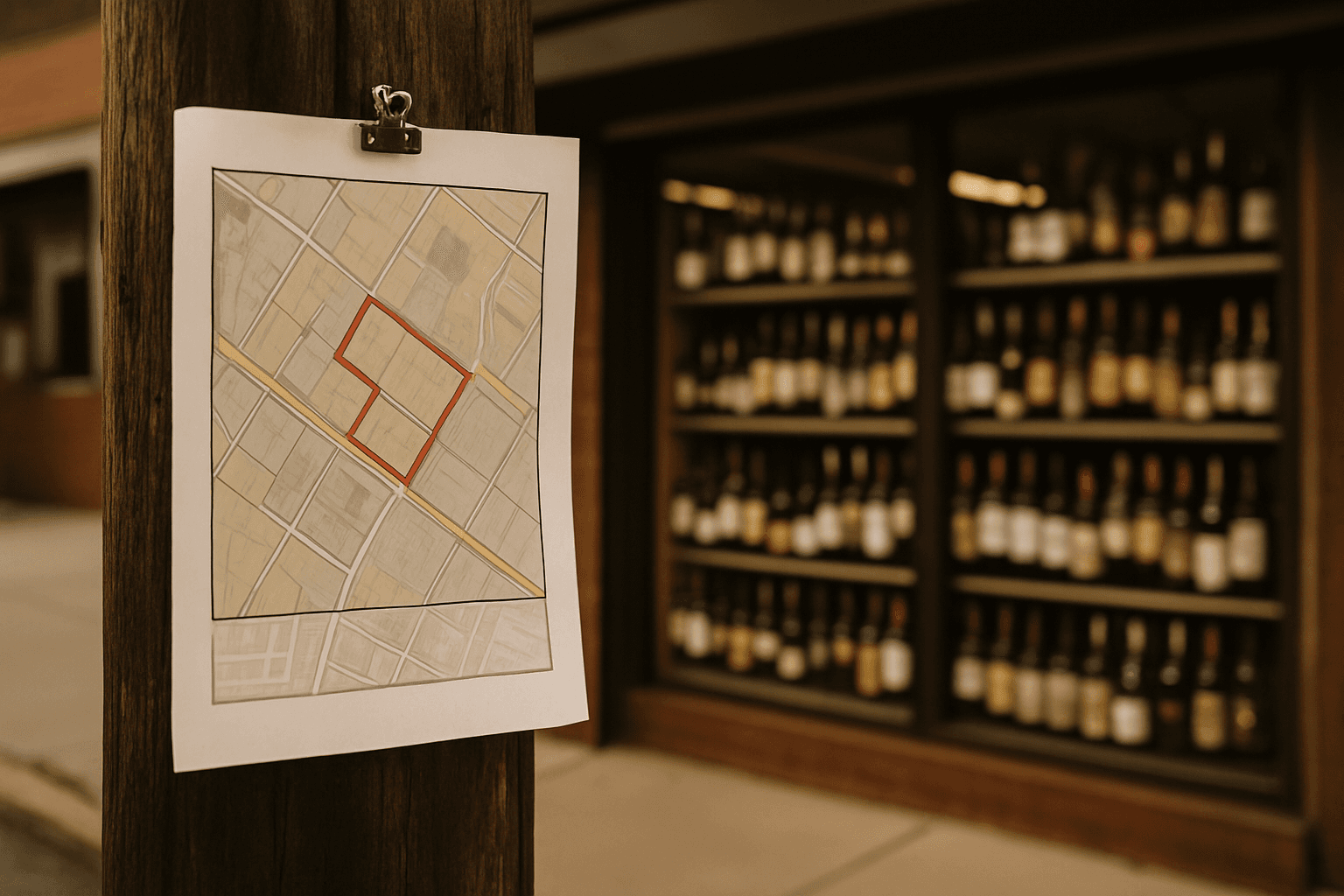
Liquor store zoning restrictions are spreading fast. Learn how new location limits impact expansion plans and how AI site selection tools give retailers an edge.
- A National Wave of Zoning Restrictions Is Reshaping Liquor Retail Expansion
- How Location Regulations Actually Work: The Patchwork Every Retailer Must Navigate
- What Lansing's Proposed Zoning Laws Mean for Your Expansion Timeline
- Why Traditional Site Selection Fails in a Shifting Regulatory Landscape
- How AI Site Selection Tools Give Liquor Retailers a Decisive Edge
Lansing is weighing new limits on where liquor stores can operate. On its own, that's a local zoning story. But zoom out and the picture changes fast. Fort Worth passed new distancing rules in January 2026. Louisville launched a formal planning study in December 2025. Chattanooga already caps distilled spirit sales as a percentage of gross revenue. Tennessee requires public referendums to approve new package stores. Liquor store zoning restrictions aren't an emerging trend, they're an accelerating national pattern, and expansion-minded retailers who aren't tracking it are already losing ground.
Here's what makes this moment different from past regulatory cycles: the speed. Fort Worth went from proposal to passed ordinance in under 90 days. The window between "we heard a rumor" and "the site is no longer compliant" is collapsing. For retailers managing 10,000+ SKUs with lean teams, manually monitoring municipal code changes across multiple expansion markets isn't just impractical, it's impossible. That's where AI-powered site selection tools enter the picture, not as futuristic novelties, but as operational necessities for anyone serious about growth in an industry where the rules change meeting by meeting.
This post breaks down exactly what's happening, why it matters to your expansion timeline, and the concrete steps you can take today to turn regulatory complexity into a competitive moat.
A National Wave of Zoning Restrictions Is Reshaping Liquor Retail Expansion
If you think Lansing's proposed limits are a local story, you're not paying close enough attention.
From Lansing to Louisville: Why Municipalities Are Tightening Location Rules
Consider the timeline. Fort Worth's City Council passed a new distancing zoning ordinance in January 2026, just two months after the proposal first surfaced. Louisville initiated a formal planning study on alcohol retail zoning in December 2025, signaling early-stage policy development that could produce binding regulations within months. Macon is pursuing similar measures. [VERIFY: Macon, specific measures and timeline need sourcing.]
Chattanooga already caps distilled beverage sales at 33% of a liquor store's total gross sales per calendar year, a revenue-based restriction that effectively functions as zoning by another name. [VERIFY: Confirm the 33% threshold and its current enforcement status.] Tennessee goes further, requiring referendum approval for package stores in cities with populations of 700 or more. [VERIFY: Confirm the 700-population threshold is accurate under current Tennessee law.]
Lansing's proposed limits fit squarely within this national pattern. Retailers who only monitor their own city council agenda are already behind. By the time a zoning proposal reaches a public vote, the political groundwork has been laid for months.
The "Not on Every Corner" Narrative Driving Policy
Fort Worth's stated goal, preventing liquor stores "on every corner", has become the template narrative for municipalities nationwide. City councils are reframing liquor retail concentration as a neighborhood revitalization issue, not just a licensing question. That framing gives elected officials significant political cover to impose stricter distancing mandates, and it resonates with residents in ways that traditional alcohol regulation arguments don't.
For expansion-minded retailers, these emerging restrictions aren't obstacles to react to, they're variables you need to model before signing a lease.
How Location Regulations Actually Work: The Patchwork Every Retailer Must Navigate
If you're planning to expand beyond your current market, here's the reality: the playbook you used to open your last location is almost certainly useless for your next one. Municipalities generally pull from three regulatory levers, and increasingly, they're pulling all three at once.
Liquor store price intelligence for independents: track big-box pricing on your top-selling SKUs and know when to mat...
Distancing Requirements, Density Caps, and Product-Mix Rules
The most common lever is minimum distancing, mandating how far apart licensed premises must sit from each other, from schools, or from places of worship. Fort Worth's January 2026 ordinance and Louisville's December 2025 planning study both center on this mechanism.
The second lever is density caps, limiting the number of licensed locations per zone, census tract, or population threshold. If the cap is hit, you're simply locked out regardless of how strong your site economics look.
The third lever is where things get operationally complex: product-mix restrictions. Chattanooga's 33% cap on distilled beverage gross sales isn't a location rule, it's a business model constraint. Your site selection process must account for what you can sell and how much, not just whether you can open a door.
State Preemption vs. Municipal Authority: Why the Rules Change Every Time You Cross a Border
Tennessee adds a democratic layer most retailers don't anticipate: package stores in qualifying cities require local referendum approval. Expansion isn't a zoning board decision, it's a public vote.
Contrast that with North Carolina, where securing a state ABC permit can significantly reduce exposure to local zoning restrictions. [VERIFY: Confirm the scope of NC state preemption, "largely exempts" may overstate the case.] State-level preemption effectively shifts the regulatory center of gravity away from municipal authority.
Then there's Michigan. The Liquor Control Code establishes statewide terms, conditions, limitations, and restrictions on manufacture, sale, possession, and transportation of alcoholic liquor. Retailers expanding into Michigan, including Lansing, must layer municipal zoning requirements on top of that state framework.
This patchwork is precisely why multi-state expansion planning demands more than a spreadsheet and a broker. AI tools built for liquor retail can cross-reference regulatory layers across jurisdictions in seconds, a process that otherwise takes weeks of legal research per market.
What Lansing's Proposed Zoning Laws Mean for Your Expansion Timeline
Reading the Policy Signals: Early-Stage vs. Enacted Restrictions
There's a critical distinction most retailers miss: the difference between a zoning proposal and an enacted ordinance, and the window between them is where expansion opportunities are won or lost.
Lansing's proposed restrictions are currently in early-stage development. But here's the pattern worth studying: Louisville's December 2025 planning study signals that political will already exists. The study is the signal. By the time final ordinance language drops, the viable sites are either locked up or off the table.
Discover 10 agentic AI workflows that automate liquor store operations, from inventory to compliance, with practical ...
Fort Worth proves how fast this moves, concept to law in under 90 days. Expansion-minded retailers relying on quarterly attorney check-ins are operating on a timeline that simply doesn't match the pace of modern municipal rulemaking.
The Real Cost of Getting Caught Flat-Footed
Consider this scenario: You sign a lease in a target Lansing neighborhood today. Six months later, a distancing ordinance passes. Your location is grandfathered in, but the competitor planning to open 800 feet away? Blocked. Liquor store zoning restrictions become your moat if you move first, or your wall if you move late.
This is exactly where AI-powered location intelligence earns its ROI, delivering real-time regulatory data layered with demographic and competitive analysis, not static reports that age out before the ink dries.
Why Traditional Site Selection Fails in a Shifting Regulatory Landscape
The Spreadsheet-and-Gut-Feel Problem
Traditional liquor retail site selection runs on traffic counts, demographics, competitor mapping, and lease economics, stitched together in spreadsheets and seasoned with intuition. What it almost never integrates: real-time regulatory data.
Retailers managing 10,000+ SKUs with skeleton crews simply don't have the bandwidth to manually cross-reference municipal code changes across multiple expansion markets. And the three-tier system compounds the problem, distributors and producers watching their retail partners struggle with site selection feel the downstream effects in route planning, account development, and market coverage gaps.
Data Gaps That Kill Deals: Demographics Without Regulatory Overlay
A site that scores perfectly on a demographic heat map may be unbuildable under new distancing rules, or require a months-long referendum process. Without regulatory overlay, location regulations become invisible landmines. The real cost isn't the lost lease deposit, it's 6–12 months of opportunity cost while competitors lock up remaining compliant locations.
How AI Site Selection Tools Give Liquor Retailers a Decisive Edge
Beverage Retail Location Intelligence: What Modern AI Platforms Actually Do
Modern platforms leverage RAG, retrieval-augmented generation, to pull and synthesize municipal code language, planning commission minutes, and proposed ordinance text in real time. Instead of hiring a land-use attorney to spend 20 billable hours parsing Lansing's zoning code, a RAG-powered system delivers a plain-English summary: what's currently allowed at a target address, what proposals are pending, and what's at risk if the council votes yes.
General commercial real estate AI tools weren't built for this. They don't understand the three-tier system, state preemption nuances, or product-mix rules. Purpose-built platforms like LiquorChat are designed around the alc-bev industry's unique regulatory complexity, the same complexity that makes this industry harder to navigate than virtually any other retail category.
Agentic Workflows and Multi-Source Data Fusion for Zoning Compliance
Here's what agentic workflows look like in practice: a single AI agent simultaneously queries demographic databases, cross-references existing liquor license locations to calculate distancing compliance, pulls competitor density data, and flags pending zoning proposals, tasks that would consume days of a human analyst's time, compressed into minutes.
Discover 9 AI-powered customer engagement strategies to boost holiday sales, personalize gift recommendations, and st...
Scale that with multi-agent swarms. One agent handles Michigan Liquor Control Code compliance. Another monitors Lansing-specific zoning proposals. A third evaluates demographic fit, household income, foot traffic, population density. An orchestration layer synthesizes their outputs into a ranked shortlist of viable sites, each scored for regulatory risk, market opportunity, and lease availability.
Tool orchestration connects these capabilities to real-world action: automated alerts when a planning commission adds alcohol retail zoning to an agenda, integration with lease platforms to surface compliant properties, and jurisdiction-specific compliance checklists generated on demand.
From Reactive to Predictive: Anticipating Regulatory Changes Before They Hit
The real edge is predictive. The pattern of cities pursuing liquor store zoning restrictions is unmistakable, and accelerating. AI models trained on legislative pattern data can flag municipalities likely to propose restrictions next, giving expansion-minded retailers a 6–12 month head start on site acquisition in at-risk markets. That's the difference between securing a compliant lease at market rate and scrambling after a vote narrows your options to zero.
Practical Playbook: 5 Steps Expansion-Minded Retailers Should Take Now
- Audit your current footprint. Cross-reference every existing and target location against local zoning restrictions, distancing minimums, density caps, proximity-to-school rules. Most retailers we talk to haven't done this. You can't defend what you don't understand.
- Monitor the regulatory pipeline. Subscribe to planning commission agendas and city council minutes in every target municipality. AI tools can scrape these agendas automatically and flag relevant keywords overnight, but even manual monitoring beats flying blind.
- Map the competitive radius. Plot every licensed retail location within two miles of your target sites. New distancing ordinances will instantly kill some options, know which survive.
- Retain local counsel now, before you need them. Cold-calling an attorney after a proposal drops is already too late.
- Evaluate AI-powered location intelligence platforms that layer regulatory data onto demographic and competitive analysis. First movers lock up compliant sites; everyone else scrambles.
The Bottom Line: Zoning Restrictions Are the New Competitive Moat
Here's the reframe expansion-minded retailers need: liquor store zoning restrictions aren't just obstacles, they're barriers to entry that protect your position. This wave is accelerating. Fort Worth. Louisville. Lansing. The pattern is clear.
The alc-bev industry has always operated under more regulation than almost any other retail category. The retailers who thrive turn compliance complexity into competitive advantage. AI-powered location intelligence lets you do that at scale, identifying compliant sites before competitors even know they exist.
The math is straightforward. Municipalities are tightening restrictions faster than most retailers can track them. The window between proposal and passed ordinance is shrinking, sometimes to weeks. Traditional site selection methods that ignore regulatory data aren't just incomplete; they're actively dangerous to your expansion timeline and your capital.
You don't need to become a zoning attorney. You need tools built for this industry, fed by real-time data, and designed to turn the most complex regulatory environment in retail into your strongest competitive advantage.
👉 LiquorChat is building AI tools purpose-built for alc-bev retailers, distributors, and producers. Stay ahead of the regulatory curve, explore how AI-powered location intelligence can protect your expansion plans. ↗