Moët & Chandon's Schiphol Pop-Up and the Experiential Retail Playbook: How AI Personalization Engines Can Bring Luxury Activation Tactics to Your Liquor Store
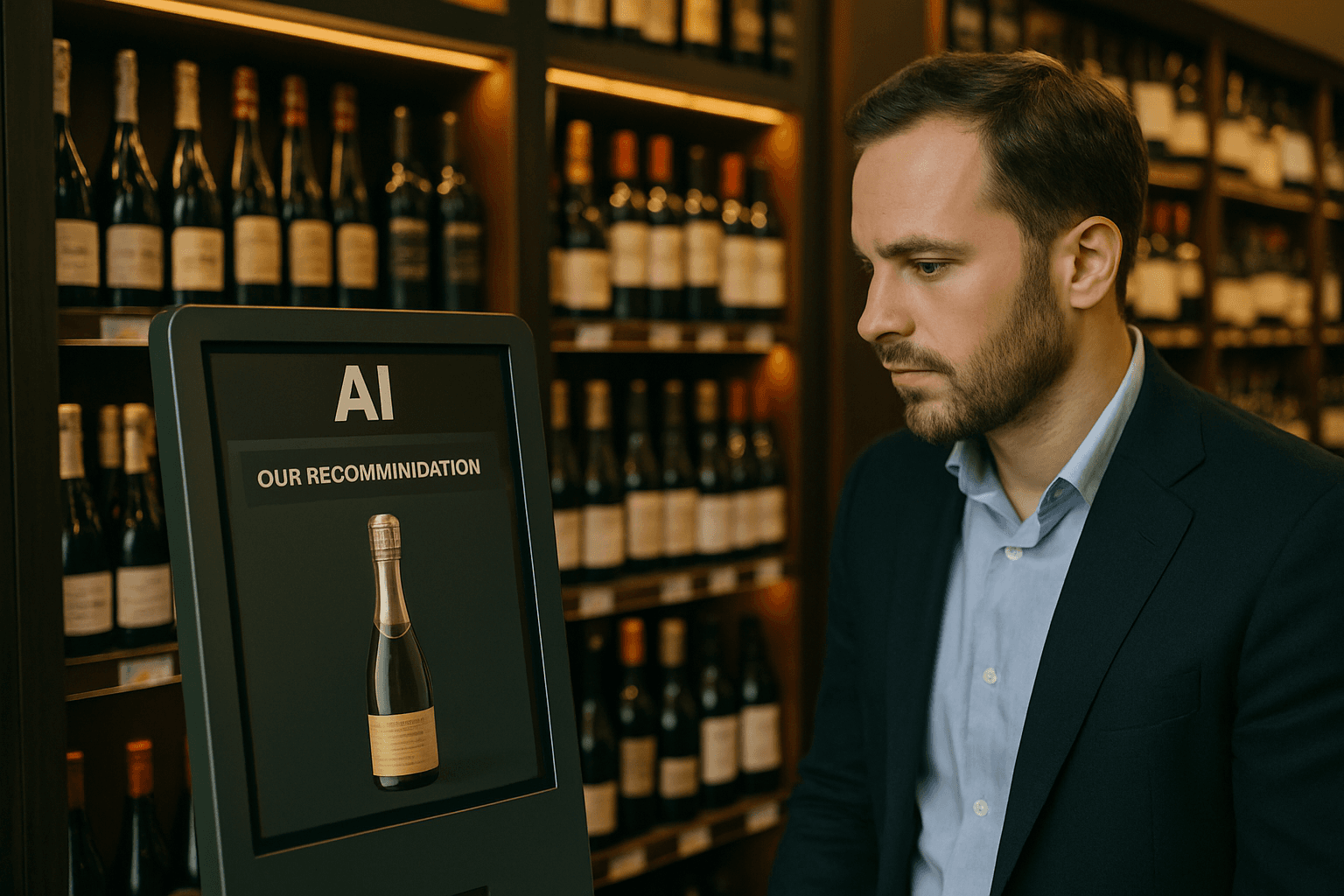
Learn how AI personalization liquor store tools let independent retailers replicate luxury brand activations like Moët's Schiphol pop-up at any budget.
- What Moët's Schiphol Pop-Up Tells Us About the Future of Alcohol Retail
- The Experiential Retail Gap: Why Most Liquor Stores Are Stuck in 2015
- How AI Personalization Engines Actually Work in Beverage Retail
- Real Deployments: Who's Already Doing This (and What You Can Learn)
- The 5-Step Playbook: Bringing Luxury Activation Tactics to Your Store with AI
Moët & Chandon's pop-up at Amsterdam Schiphol isn't just a pretty activation, it's a masterclass in everything most liquor stores get wrong. A tight product selection instead of 10,000 SKUs screaming for attention. Occasion-based selling instead of price tags doing all the talking. A human guide who reads the customer and matches them to the right bottle in under two minutes. The result is a conversion machine wrapped in velvet. And for years, that machine was only available to brands with eight-figure marketing budgets.
That era is ending. The convergence of AI personalization engines, taste-profile matching, and agentic workflow architectures means the core mechanics behind Moët's activation, curation, personalization, occasion-driven selling, immersive discovery, are now deployable in any AI personalization liquor store strategy, whether you're running a single independent shop or a fifty-location regional chain. BJ's is doing it at the shelf. Albertsons is doing it for party planning. Johnnie Walker used AI to produce 50,000 unique bottles at Dubai Duty Free [VERIFY: exact count and date]. The technology isn't theoretical. It's in production, and it's reshaping who gets to play the experiential retail game.
This post breaks down exactly how the luxury activation playbook works, why most liquor stores are structurally locked out of it without AI, how modern personalization engines actually function under the hood, RAG, tool orchestration, agentic workflows, and gives you a concrete, five-step implementation plan plus quick-hit tactics you can deploy this week. No fluff. No hype. Just the operational blueprint.
What Moët's Schiphol Pop-Up Tells Us About the Future of Alcohol Retail
Walk through Amsterdam's Schiphol Airport and you'll encounter something that looks nothing like a liquor store, and that's exactly the point. Moët & Chandon's pop-up activation transforms a transient corridor into a curated champagne salon: a tight, intentional product selection replaces endless shelf runs, brand ambassadors guide visitors through personalized recommendations based on occasion and taste, and immersive storytelling wraps the entire experience in sensory detail. It's not a store. It's a moment. [VERIFY: confirm this activation is current/recent and source details]
And it's a blueprint worth stealing.
The Luxury Activation Formula: Curation, Exclusivity, and Sensory Experience
Strip away the LVMH budget and what Moët built at Schiphol reduces to four operational pillars: curated selection (fewer SKUs, higher relevance), occasion-based selling ("celebrating tonight?" not "what's your price range?"), personalized guidance (human ambassadors reading the customer), and immersive discovery (storytelling that makes browsing feel like an experience, not a chore).
These aren't novel ideas. They're just expensive to execute with humans alone, which is why they've historically been confined to luxury activations and travel retail.
But AI is already crashing that party. Johnnie Walker's "1 of 1" campaign at Dubai Duty Free produced thousands of uniquely AI-designed bottles, each one personalized, each one unrepeatable [VERIFY: exact count, date, and campaign details]. That's not a marketing gimmick bolted onto a bottle. That's an AI personalization engine embedded directly into a luxury activation, merging curation with individual identity at scale.
Why This Matters Beyond Travel Retail
This isn't a one-off luxury stunt. Trend Hunter has catalogued dozens of innovative "booze boutiques" globally, experiential retail concepts reimagining how consumers discover and buy alcohol [VERIFY: exact count of 44]. The trajectory is unmistakable.
And the tools are democratizing fast. BJ's Wholesale Club deployed Looma's digital platform for personalized wine and cocktail recommendations at the shelf [VERIFY: January 2026 date]. Shortly after, Albertsons launched its AI-equipped "Celebrations" party planning platform, occasion-based selling, automated [VERIFY: February 2026 date]. These are grocery chains, not champagne houses.
Here's the core thesis: the playbook behind these multi-million-dollar activations, personalization, curation, occasion-based selling, immersive discovery, is no longer gated by LVMH budgets. An AI recommendation engine for beverage retail can now deliver the functional equivalent of a trained brand ambassador to every customer interaction. For a retailer managing 10,000+ SKUs with a team of five, that's not a luxury. It's a lifeline.
The experiential retail liquor store isn't a future concept. It's an operational model that AI makes viable today, at every scale.
The Experiential Retail Gap: Why Most Liquor Stores Are Stuck in 2015
Walk into a typical independent liquor store and you're looking at somewhere between 8,000 and 12,000 SKUs crammed onto shelves [VERIFY: source for typical SKU range]. Now look behind the counter: maybe three employees on a good day, one of whom started last month. The person who actually knew bourbon? She left in Q2. Her product knowledge left with her.
Discover 7 AI-powered customer engagement tactics that transform cross-selling for liquor stores. Practical strategie...
Meanwhile, your customer is standing in the whiskey aisle, research suggests the average browse time hovers around seven minutes before decision fatigue kicks in [VERIFY: source needed]. The outcome? They grab the same bottle of Bulleit they bought last time. Or they walk out entirely.
The SKU Overload Problem
Contrast that with what Moët builds at Schiphol. Six to ten SKUs. A trained brand ambassador who asks whether you're celebrating an anniversary or gifting a client. A curated journey from discovery to purchase. Conversion rates in these luxury activations are dramatically higher, not because the product is necessarily better than what's on your shelves, but because the experience is personalized.
This isn't just a luxury play anymore. From BJ's deploying AI-powered recommendations at the shelf edge to Albertsons building full occasion-based party planning into its digital experience, the grocery and wholesale channels are already investing heavily. Try-before-you-buy concepts are gaining traction in India's emerging liquor superstores. The experiential model is going mainstream.
The Data Desert Between You and Your Customer
Here's the truth: independent retailers don't have a product problem. You probably carry bottles that would outshine half of what's in a duty-free pop-up. What you lack is the data infrastructure and recommendation layer to match the right bottle to the right customer at the right moment.
That gap, between a wall of 10,000 options and a personalized suggestion that actually converts, is exactly what an AI personalization liquor store strategy closes. An AI recommendation engine acts as your always-on, never-quitting brand ambassador: one that remembers every customer's purchase history, understands flavor profiles across every SKU, and never calls in sick.
How AI Personalization Engines Actually Work in Beverage Retail
Let's cut through the buzzwords. When we talk about AI personalization in a liquor store, we're not talking about a "customers also bought" widget slapped onto your e-commerce page. That's a parlor trick. We're talking about a layered intelligence system that fundamentally changes how you sell, and what your margins look like at the end of the month.
A modern AI recommendation engine for beverage retail operates across three distinct layers:
- Customer data ingestion, Purchase history, browsing behavior, loyalty program data, stated preferences ("I like smoky mezcals," "nothing over $40"). Every transaction and interaction feeds the model.
- Product knowledge graph, This is where it gets industry-specific. Tasting notes, flavor profiles, producer data, regional attributes (Willamette Valley vs. Côtes du Rhône), price positioning, and critically, your margin data. The AI knows that the $28 Malbec on shelf 3 delivers better GP than the $32 one next to it.
- Contextual reasoning, Occasion (wedding vs. Tuesday night), season (rosé in May, barrel-aged stouts in November), trending categories, and local market dynamics. A store in Austin gets different signals than one in Boston.
This isn't theoretical. Albertsons' Vine & Cellar Reserve platform uses Preferabli's AI-driven product discovery engine for DTC wine shipping, taste-profile AI matching customers to bottles based on their actual palate preferences, not just price or popularity [VERIFY: Preferabli partnership details]. BJ's brought a similar philosophy into the physical store with Looma's in-club recommendation platform.
From Collaborative Filtering to Taste-Profile AI
Traditional collaborative filtering says: "People who bought X also bought Y." It's blind to why. Taste-profile AI maps a customer's demonstrated preferences across flavor dimensions, oak intensity, residual sugar, tannin structure, smoke character, botanical complexity, and matches them against your entire catalog. The difference? Collaborative filtering recommends the obvious. Taste-profile AI surfaces the $22 Côtes du Ventoux that a Châteauneuf-du-Pape lover didn't know existed, at a margin that makes you smile.
Johnnie Walker's "1 of 1" campaign demonstrated this personalization philosophy at scale: every customer gets something that feels bespoke, whether that's a uniquely designed bottle or a recommendation tailored to their palate.
RAG, Tool Orchestration, and Why Architecture Matters for Alcohol Retail
Here's where architecture separates real AI recommendation engines from dressed-up search bars.
Retrieval-Augmented Generation (RAG) allows an AI system to pull from your specific inventory database and product knowledge base, not generic Wine Spectator descriptions, to generate recommendations reflecting what's actually on your shelves and in your warehouse right now. When a customer asks, "What's a good bourbon for an Old Fashioned under $35?" the system retrieves from your live catalog, your tasting notes, your margin data, and generates a response grounded in your reality. Not the internet's reality. Yours.
Discover how AI recommendation engines for liquor stores create personalized shopping experiences that boost loyalty ...
But the real unlock is tool orchestration. A well-architected AI personalization engine doesn't just recommend a bottle, it checks real-time inventory (do you actually have 6 bottles or 1?), applies relevant promotions, considers your margin targets, and can trigger a reorder alert to your distributor before you stock out. This is agentic workflow design: the AI coordinates multiple tools and data sources to complete a complex task end-to-end, without a human toggling between four different screens.
Contrast that with a simple "you might also like" carousel. One drives basket size, protects margin, and keeps your shelves stocked. The other just... sits there.
Real Deployments: Who's Already Doing This (and What You Can Learn)
The experiential retail liquor store concept isn't theoretical. Multiple players are already deploying AI personalization in alcohol retail, and the results are reshaping how the industry thinks about the shelf edge.
BJ's Wholesale Club: AI at the Shelf
BJ's deployed Looma's in-club digital platform to deliver personalized wine and cocktail recommendations at the physical point of decision [VERIFY: January 2026 date]. Not on an app. Not on a website. At the shelf, where the vast majority of purchase decisions actually happen [VERIFY: commonly cited as 70%+ per POPAI/Shop! Association research]. This is the critical bridge between digital AI and in-store experience. Think about what Moët achieved with trained ambassadors at Schiphol, then imagine scaling that consultative moment across hundreds of club locations simultaneously.
Albertsons' 'Celebrations': Occasion-Based AI Curation
Albertsons raised the bar with its AI-equipped "Celebrations" party planning platform [VERIFY: February 2026 date]. This isn't single-bottle recommendations, it's full occasion-based curation. "I'm hosting a dinner for eight, we're serving salmon, budget is $150 for wine." The AI shopping assistant handles the rest. This is exactly the personalized, consultative experience that Moët's pop-up ambassadors deliver, but scaled through technology to serve thousands of customers simultaneously.
BottleCapps and the Independent Retailer Stack
Here's where it gets real for independents. Platforms like BottleCapps are enabling AI-driven personalization for stores of every size, driving conversions, loyalty, and repeat purchases without six-figure activation budgets. The vendor ecosystem is maturing fast.
The bottom line for retailers: You don't need to build custom AI. The question has shifted from "does this technology exist?" to "which solution fits my operation?" Whether you're running one store or fifty, the tools to deliver Moët-level personalization are already on the market, and your competitors are evaluating them right now.
The 5-Step Playbook: Bringing Luxury Activation Tactics to Your Store with AI
You don't need Moët's budget. You need their logic. Here's how to build an AI personalization liquor store strategy that borrows from the luxury playbook, adapted for independent and regional operators.
Step 1: Digitize Your Customer Knowledge
If your customer data lives in your staff's heads, it walks out the door when they do. Start with your POS loyalty data. Even basic purchase history, frequency, category preferences, average ticket, gives an AI engine enough signal to start personalizing. You don't need a data science team. You need structured records of who buys what, how often, and at what price point. If you have no loyalty program, that's step zero. Get one running before anything else.
Step 2: Build Your Product Intelligence Layer
Your POS knows SKUs and prices. An AI recommendation engine needs more: flavor profiles, tasting notes, producer stories, food pairings, occasion tags. Platforms like Preferabli are building these product knowledge graphs across wine, spirits, and beer. Your job is to connect your inventory feed to one. This is the intelligence layer that transforms a transaction database into a personalization engine.
Step 3: Deploy AI-Powered Touchpoints (Digital and Physical)
Start with one touchpoint where customers currently get stuck, usually the wine wall or the whiskey aisle. Your version might be a chatbot on your website, a recommendation widget in your e-commerce flow, or AI-generated shelf talkers. One touchpoint, done well, beats five done poorly.
Step 4: Create Occasion-Based Curation Flows
This is where you replicate the luxury activation playbook. Instead of "here's a Pinot Noir you might like," build AI flows around moments: "hosting Thanksgiving," "gift for a whiskey lover," "first date dinner." Albertsons' Celebrations platform is the enterprise version of this concept. You can start simpler with curated landing pages or in-store displays driven by AI-selected products. Occasions convert because they match how people actually shop.
Liquor store price intelligence for independents: track big-box pricing on your top-selling SKUs and know when to mat...
Step 5: Close the Loop with Automated Engagement
The retention layer is what separates experiential retail concepts from one-off gimmicks. AI tools now automate loyalty rewards, promotional offers, and personalized messages based on buying history. When a customer who bought Moët Rosé for Valentine's Day hasn't been back in 60 days, an automated, personalized message with a relevant offer brings them back. Hyper-personalization at scale doesn't require 50,000 custom bottles. Your version is a triggered SMS with a curated recommendation and a loyalty incentive. Same principle, fraction of the cost.
Quick Help Guides: 3 AI Personalization Tactics You Can Implement This Week
You don't need Moët's budget or Johnnie Walker's custom bottle campaign to bring AI personalization to your store. Here's what you can do right now.
For Retailers: The 30-Second Shelf Talker Upgrade
Pull your top 20 SKUs by velocity from your POS. Paste them into ChatGPT or Claude with this prompt: "Write a 15-word shelf talker for each product that includes a food pairing and an occasion suggestion." Print. Laminate. Deploy today. You just created experiential retail merchandising at zero cost, contextual selling that mirrors what major chains are spending millions to build digitally, but on your timeline and your budget.
For Distributors: AI-Powered Rep Talking Points
Before your next ride-with, pull the retailer's top 10 categories by depletion and their gaps versus market trends. Feed that into an AI tool and generate a one-page "opportunity brief" with three recommended SKU additions tied to occasions and local demographics. You just transformed a routine call into a consultative, data-driven conversation, the kind of insight that earns shelf space.
For Producers/Brand Managers: Micro-Activation Data Packets
Build a one-pager for your top accounts: flavor profile, occasion positioning, food pairings, and a QR code linking to a short brand story video. Use AI to customize the occasion positioning for each account's customer demographics. This gives every retailer the same ammunition a Moët pop-up ambassador carries, scaled across your entire distribution footprint, a practical AI-powered activation deployed where it matters most: at the point of sale.
The Bottom Line: Experiential Retail Isn't a Luxury, It's a Survival Strategy
Moët can afford a Schiphol pop-up. Johnnie Walker can commission AI-designed bottles for Dubai Duty Free. Albertsons can build an entire AI-equipped party planning platform. But strip away the budgets and the underlying playbook is identical: know your customer, personalize the experience, sell the occasion, not just the product.
That playbook is now accessible to any retailer willing to adopt AI personalization tools purpose-built for beverage alcohol.
Bridging the Three-Tier Data Divide
The three-tier system has historically made personalization nearly impossible for independents. Producers hold brand data. Distributors hold depletion data. Retailers hold customer data. None of it talks to each other. AI recommendation engines built on RAG architectures, systems that ingest and reason across multiple fragmented data sources, are the first practical bridge across these silos, turning experiential retail concepts from aspiration into daily operation.
Where LiquorChat Fits In
This is exactly the problem LiquorChat was built to solve. Purpose-built for alc-bev's unique regulatory, operational, and data challenges, three-tier compliance, 10,000+ SKU complexity, occasion-based selling, LiquorChat brings agentic AI workflows to every tier of the supply chain. As multi-agent AI systems mature, expect engines that simultaneously optimize customer satisfaction, margin targets, inventory turnover, and distributor relationships in real time.
The stores building their data foundations now will capture that value first.
What to Do Next
The gap between knowing this playbook exists and actually running it comes down to one thing: your data foundation. Every tactic in this post, from AI-generated shelf talkers to full occasion-based curation engines, depends on structured customer and product data that most stores haven't started collecting yet.
Start today. Tag occasions in your POS. Export your top 100 customers. Build flavor profiles for your top 200 SKUs. These are small moves that compound fast once an AI personalization liquor store platform sits on top of them.
Want to see how LiquorChat brings agentic AI workflows to every tier of the alc-bev supply chain? Talk to our team ↗ and we'll show you exactly how the technology maps to your operation, whether you're a single-store independent, a regional distributor, or a producer trying to get closer to the consumer. The luxury playbook is open. The only question is whether you pick it up.