Quick Guide: How to Use AI to Write Better Shelf Talkers in 30 Seconds
# Quick Guide: How to Use AI to Write Better Shelf Talkers in 30 Seconds
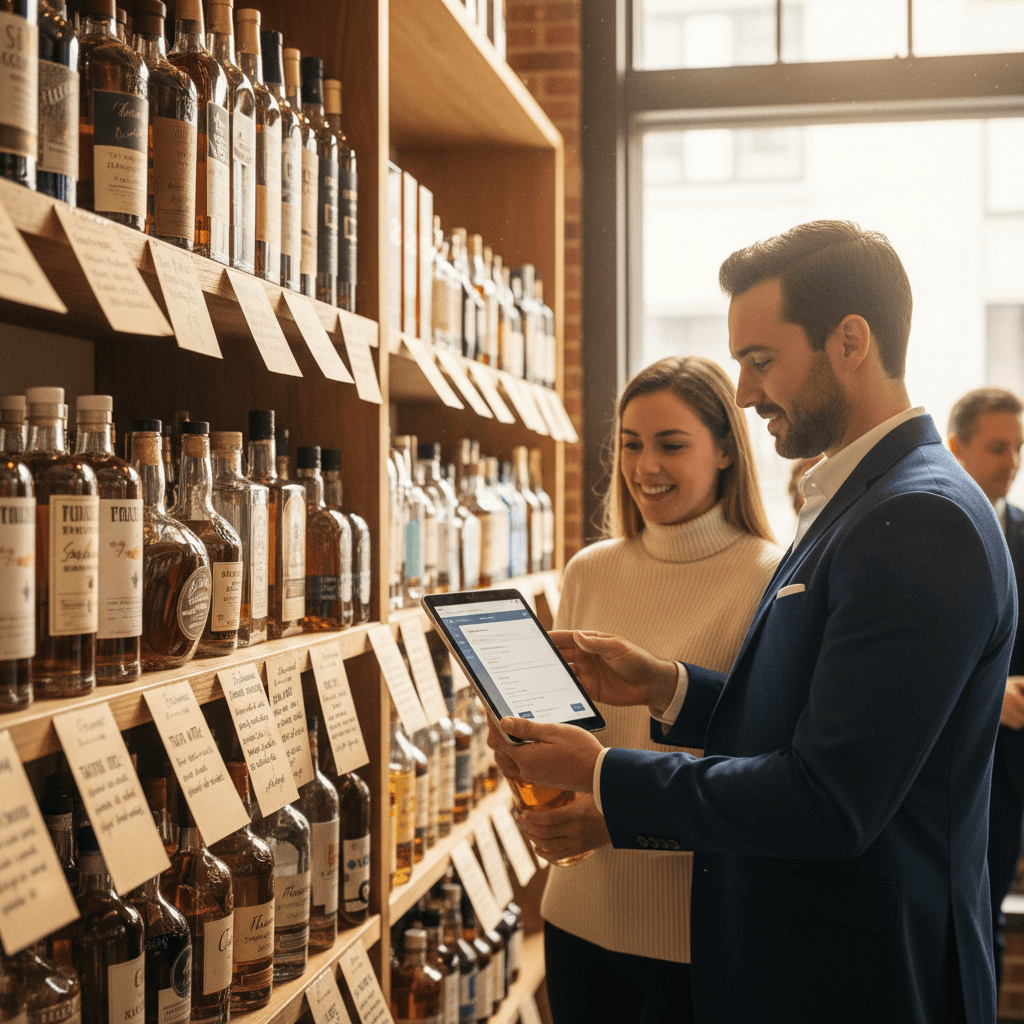
Shelf talkers are the hardest-working salespeople in your store. They work every shift, never call in sick, and influence purchase decisions at the exact moment a customer is standing in front of a product with their wallet out. Yet most stores either skip them entirely or write them once and never update them.
The reason is simple: writing good shelf talkers takes time. Researching tasting notes, crafting customer-friendly language, formatting for print, a single shelf talker can take 10-15 minutes. Multiply that by 50-100 featured products, and you are looking at a full workweek of writing.
AI reduces that to 30 seconds per shelf talker. Here is exactly how to do it.
## Step 1: Gather Your Inputs (10 Seconds)
Before you prompt the AI, grab these details about the product. You probably know most of them off the top of your head:
- **Product name and producer** (e.g., "Widow Jane 10 Year Bourbon by Widow Jane Distillery") - **ABV** (e.g., 45.5%) - **Origin** (e.g., Brooklyn, NY, blended from bourbons distilled in Kentucky, Tennessee, and Indiana) - **Age statement** (e.g., 10 years) - **Your retail price** (e.g., $69.99) - **Anything notable**, awards, limited release, unique production method, your personal tasting experience
You do not need all of these. Product name, ABV, and price are the minimum. The more context you provide, the better the output.
## Step 2: Use This Prompt Template (5 Seconds)
Copy and paste this template into ChatGPT, Claude, or any AI tool. Fill in the brackets:
``` Write a retail shelf talker for [PRODUCT NAME] by [PRODUCER]. Details: [ABV], [ORIGIN], [AGE/TYPE], [PRICE]. Additional notes: [ANYTHING NOTABLE].
Rules: - 40-60 words maximum - Include 2-3 specific tasting notes (not generic) - Include one food pairing suggestion - Conversational tone, like a knowledgeable friend, not a textbook - End with the price - Do not make health claims ```
## Step 3: Review and Print (15 Seconds)
The AI will return something like this:
> **Widow Jane 10 Year Bourbon** > Brooklyn meets Kentucky in this rich, complex bourbon. Expect butterscotch and toasted oak up front, with a long finish of dark cherry and baking spice. Incredible in an Old Fashioned, but honestly? It deserves to be sipped neat alongside a good steak. > **$69.99**
Quick quality check: - Are the tasting notes specific (not just "smooth and flavorful")? - Does the tone match your store's personality? - Is the price correct? - Is it under 60 words?
If anything is off, just tell the AI: "Make it more casual" or "Replace the food pairing with a cocktail suggestion" or "Emphasize that this is a limited allocation."
## Advanced: Batch Processing
The real time savings come from batching. Instead of one product at a time, give the AI a list:
``` Write shelf talkers for all of the following products using the format above. Same rules apply (40-60 words, tasting notes, food pairing, conversational tone, price).
1. Buffalo Trace Bourbon - 45% ABV - $27.99 2. Elijah Craig Small Batch - 47% ABV - $32.99 3. Four Roses Single Barrel - 50% ABV - $44.99 4. Knob Creek 9 Year - 50% ABV - $36.99 5. Maker's Mark 46 - 47% ABV - $38.99 ```
Five shelf talkers in a single prompt. Total time: about 45 seconds including review.
## Advanced: Category-Specific Tone
Different categories benefit from different tones:
**For craft beer:** More casual, emphasize the brewer's story and hop/malt profiles. Mention IBUs if relevant.
``` Tone: Enthusiastic beer nerd talking to a curious friend. Include IBU if it is an IPA or pale ale. Mention the brewery backstory in one sentence if interesting. ```
**For wine:** More elegant but not intimidating. Emphasize food pairing.
``` Tone: Approachable sommelier, knowledgeable but never snobby. Lead with the food pairing. Use sensory language (aromas, textures) but avoid wine jargon unless you define it. ```
**For spirits:** Balance between expertise and accessibility.
``` Tone: Your favorite bartender explaining why this bottle is special. Mention the best way to drink it (neat, on the rocks, in a specific cocktail). ```
## Pro Tips for Better Results
### Tip 1: Add Your Personal Experience
The best shelf talkers have a human touch. If you have tasted the product, tell the AI:
"I tasted this at a whiskey event and the finish was surprisingly long, at least 30 seconds. The butterscotch note is more like browned butter. I like it better than Woodford Reserve at a similar price."
The AI will incorporate your personal impressions, making the shelf talker authentic rather than generic.
### Tip 2: Specify Your Customer Base
Adding "Our customers are mostly suburban professionals aged 35-55 who are whiskey-curious but not experts" dramatically changes the output. The AI will avoid jargon and use more inviting language.
### Tip 3: Include Comparison Points
"Position this against Bulleit Bourbon ($28.99) and Woodford Reserve ($37.99), this should be presented as the premium step-up option." This gives the AI context about your shelf layout and pricing strategy.
### Tip 4: Seasonal Rotation
Set a monthly or quarterly reminder to regenerate shelf talkers for your featured products. Seasonal context makes them more relevant:
"It is December. Emphasize gift-giving and holiday cocktail potential." versus "It is July. Emphasize refreshing serves and outdoor entertaining."
### Tip 5: A/B Test Your Shelf Talkers
Generate two versions and test which one drives more sales:
"Write two different shelf talkers for this product. Version A should lead with tasting notes. Version B should lead with a cocktail recommendation."
Run each version for two weeks and compare sales data. Over time, you will learn what resonates with your specific customers.
## Formatting for Print
Once you have your shelf talker text, you need to format it for your actual shelf tags. Here is a prompt for that:
``` Format the following shelf talker for a 3.5" x 2" shelf tag. Use this layout: - Product name in bold (top line) - Body text (2-3 lines) - Price in bold (bottom right) Keep the total text under 50 words to ensure readability at arm's length. ```
Many AI tools can also generate the actual design. If you use Canva, you can paste the AI-generated text directly into a shelf talker template.
## The Math: Time and Money Saved
Let us say you maintain shelf talkers for 75 featured products and refresh them quarterly:
**Without AI:** - 75 products x 12 minutes each = 15 hours per refresh - 4 refreshes per year = 60 hours - At $25/hour (manager time) = **$1,500/year**
**With AI:** - 75 products in batches of 5 = 15 prompts x 2 minutes each = 30 minutes per refresh - 4 refreshes per year = 2 hours - AI cost: ~$0.50 total per year - At $25/hour = **$50/year + $0.50 AI cost**
**Annual savings: $1,449.50 and 58 hours of your life back.**
And the AI-generated shelf talkers are arguably better, more consistent in quality, more specific in tasting notes (they draw from massive databases of professional reviews), and easier to customize per audience.
## Common Mistakes to Avoid
1. **Using generic prompts**, "Write a description for Maker's Mark" gives you generic output. Always add ABV, price, and your customer context. 2. **Not reviewing the output**, AI occasionally gets tasting notes wrong or invents awards. Spend 10 seconds scanning each shelf talker. 3. **Making them too long**, Nobody reads a 100-word shelf talker in a store aisle. 40-60 words is the sweet spot. 4. **Forgetting compliance**, Do not let the AI write health claims. Add "Do not make health claims" to every prompt. 5. **One-and-done**, Shelf talkers should evolve. Refresh them seasonally at minimum.
## Key Takeaways
- **AI reduces shelf talker creation from 10-15 minutes to 30 seconds per product** - **Use the template in this article** as your starting point, fill in the brackets and go - **Batch process** 5-10 products at a time for maximum efficiency - **Add your personal tasting experience** to make shelf talkers authentic - **Refresh quarterly** with seasonal context for maximum sales impact - **A/B test** different approaches to learn what your customers respond to - **The ROI is undeniable:** $1,450/year in time savings for a task most stores avoid entirely