Voice Commerce and Conversational AI: The Next Frontier for Beverage Retail
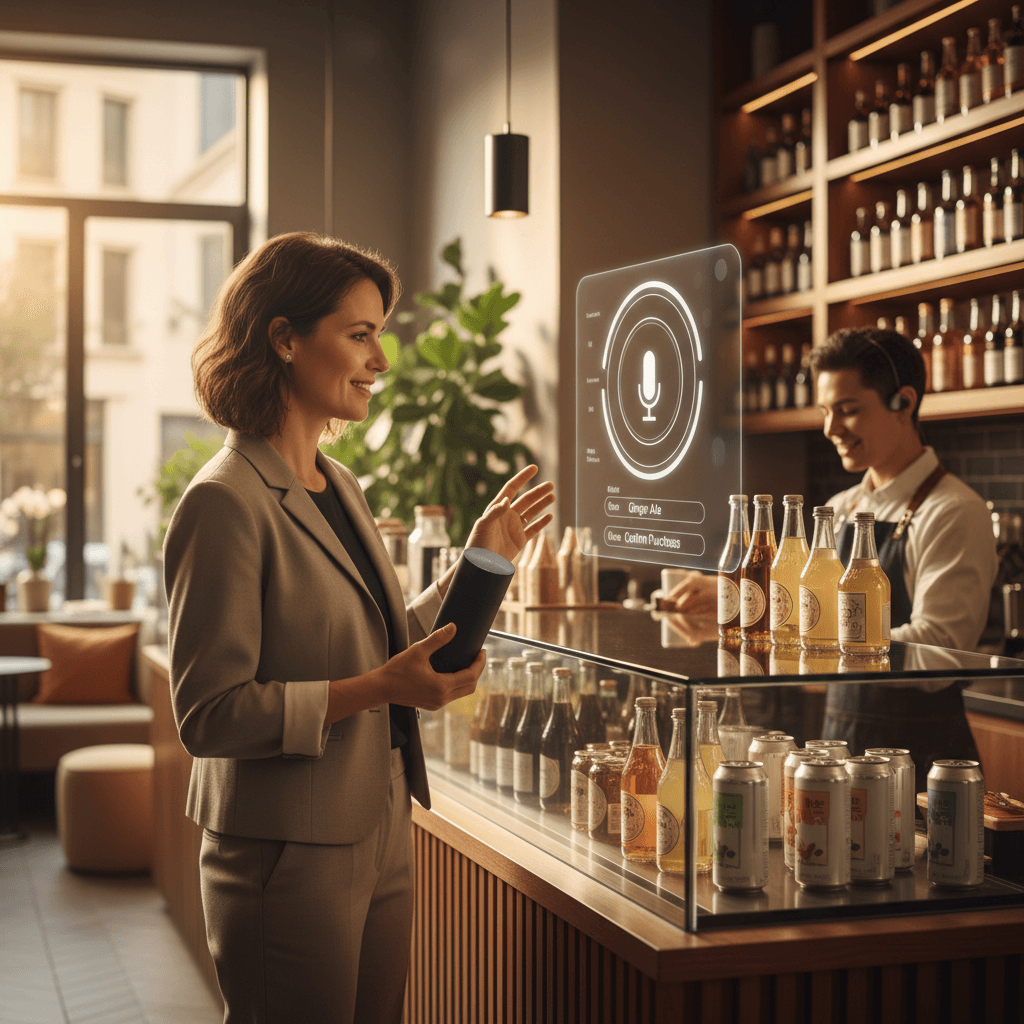
# Voice Commerce and Conversational AI: The Next Frontier for Beverage Retail
The keyboard and mouse era of software is ending. The next interface for business technology is the same one humans have used for 200,000 years: voice. And beverage retail, an industry where operators have their hands full (literally, stacking cases and managing shelves), stands to benefit more than almost any other sector.
Voice commerce is not futuristic speculation. The underlying technology is mature. What is missing is the application layer that connects voice interfaces to beverage-specific systems. That gap is closing fast.
## The State of Voice Technology in 2026
Let us separate hype from reality:
### What Works Today - **Speech-to-text accuracy** has reached 95-98% for standard English, even in noisy environments (like a busy stockroom) - **Natural language understanding (NLU)** can parse complex, multi-part queries: "Show me all tequilas under $40 that we sold more than 10 cases of last quarter" - **Text-to-speech** has become nearly indistinguishable from human voice, enabling natural conversational responses - **Real-time processing**, latency is under 500ms for most voice AI systems, fast enough for natural conversation
### What Is Emerging - **Multi-turn conversation**, AI that remembers context across a long dialogue (not just single commands) - **Ambient computing**, Always-listening systems that proactively alert you when something needs attention - **Multimodal interfaces**, Voice combined with visual displays (think: you ask about a product and a screen shows the bottle, reviews, and sales data simultaneously)
### What Is Still Early - **Noisy environment handling**, Background music, multiple speakers, and equipment noise still degrade accuracy - **Industry-specific vocabulary**, AI sometimes struggles with obscure wine regions, distillery names, and spirit terminology - **Accent and dialect handling**, Improving rapidly but not yet universal
## Voice Ordering: From Fiction to Function
Imagine this scenario. It is 7 AM on Monday. You are walking through your store doing your morning walkthrough before opening. You notice the bourbon section looks thin.
**You:** "Hey, check bourbon inventory levels and flag anything below reorder point."
**AI:** "You have 14 bourbon SKUs below reorder point. The most urgent are Buffalo Trace at 3 units remaining, your reorder point is 24, and Maker's Mark at 8 units remaining with a reorder point of 18. Your next scheduled delivery from Southern Glazer's is Wednesday. Would you like me to draft a reorder?"
**You:** "Yes, draft a reorder for all 14 SKUs at standard quantities. Add a case of that new Smoke Wagon I sampled last week."
**AI:** "Done. I have drafted a purchase order for 14 SKUs at standard reorder quantities plus one case of Smoke Wagon Uncut Unfiltered Bourbon, wholesale $42.00. Total order value is $3,847. The PO is saved as a draft in your ordering system. Would you like me to send it to your Southern Glazer's rep, or would you prefer to review it first?"
**You:** "Send it. And remind me to check sell-through on the Smoke Wagon in two weeks."
**AI:** "Order sent to Marcus at Southern Glazer's. I have set a reminder for March 31st to review Smoke Wagon sell-through data."
This entire interaction took 45 seconds, your hands never left your coffee cup, and you just completed a task that typically requires 15-20 minutes of screen time in an ordering system.
## Natural Language Inventory Management
Voice interfaces are particularly powerful for inventory tasks because they let you interact with data while your eyes and hands are doing physical work:
### Receiving Deliveries
**Traditional process:** Driver arrives, you take the paper invoice, manually check each item against the delivery, enter received quantities into your POS, note any discrepancies. Time: 30-45 minutes for a typical delivery.
**Voice-assisted process:** "Start receiving delivery from Republic National. PO number 4782." As you unload each case, you call out: "12 Buffalo Trace 750, confirmed." "6 Hendrick's Gin 750, confirmed." "24 Modelo 12-pack, wait, the PO says 36. Short 12 units." The AI tracks counts, flags discrepancies in real time, and submits the received inventory to your POS when you are done. Time: 15-20 minutes.
### Cycle Counting
**Traditional process:** Print a count sheet, walk the aisles, count each product, return to the office, enter the counts into the POS, reconcile discrepancies. Time: 2-4 hours for a full count.
**Voice-assisted process:** Walk the aisles and call out counts: "Tito's 750, shelf count 18." "Tito's 1.75, shelf count 7." "Casamigos Blanco 750, shelf count 12." The AI records counts, compares to system inventory, and immediately flags discrepancies: "Casamigos Blanco shows 18 in the system but you counted 12. That is a variance of 6 units. Would you like to flag this for investigation?" Time: 45-90 minutes.
### Shelf Management
Walking the floor with a voice assistant enables real-time shelf management decisions:
"What is the velocity on this Aperol? How does it compare to Campari?"
"Aperol 750ml is selling 4.2 units per week, up 15% month-over-month. Campari 750ml is at 2.8 units per week, flat. Aperol has earned additional facing based on velocity."
"Give it two facings instead of one. What should I reduce to make room?"
"Based on velocity, your slowest-moving product in this section is Cynar at 0.3 units per week. Consider reducing Cynar to back stock or moving it to a less prominent position."
## Conversational Product Search
This is where voice AI gets genuinely exciting for customer-facing applications. Instead of browsing or searching by keyword, customers (or staff helping customers) can describe what they want in natural language:
### Customer Scenario
**Customer:** "I am hosting a dinner party Saturday. We are making Italian food, pasta with a red sauce and grilled lamb. I need wine recommendations. Budget is around $20-30 a bottle and I need three bottles."
**AI assistant (via staff tablet or in-store kiosk):**
"For your Italian dinner, I would recommend:
1. **Marchesi Antinori Chianti Classico Riserva 2020** ($24.99), A classic Tuscan red that was practically made for tomato-based pasta. Cherry and dried herb notes will mirror the sauce.
2. **Poderi Colla Nebbiolo d'Alba 2021** ($27.99), Lighter and more aromatic than Barolo but with the same elegance. The earthy quality pairs beautifully with grilled lamb.
3. **Cusumano Nero d'Avola 2022** ($18.99), A rich Sicilian red that bridges both dishes. Dark fruit and a touch of spice. Your most versatile option.
Total: $71.97. All three are in stock. Would you like me to add anything else, perhaps a white for aperitivo?"
This interaction demonstrates several capabilities that simple keyword search cannot match: - **Context understanding**, the AI parsed the occasion, the food, the budget, and the quantity - **Domain expertise**, it selected wines that pair with specific dishes, not just random Italian wines - **Inventory awareness**, it confirmed all three are in stock - **Upselling**, it naturally suggested an addition without being pushy
## Building Voice Into Your Business
You do not need to build a voice assistant from scratch. Here is a practical roadmap:
### Phase 1: Voice-to-Text for Data Entry (Available Now)
Use your phone's built-in voice typing for any text input: - Dictate inventory counts into a spreadsheet - Voice-type product descriptions for your website - Dictate notes during distributor meetings
Cost: $0. Every modern smartphone has this capability.
### Phase 2: Voice-Activated AI Queries (Available Now)
Use ChatGPT's voice mode or similar tools for conversational business queries: - Ask about sales trends while walking the floor - Get product recommendations for customers in real time - Draft communications hands-free
Cost: $20/month for ChatGPT Plus.
### Phase 3: Integrated Voice Workflows (Emerging)
Connect voice interfaces to your business systems: - Voice-activated POS queries - Voice-controlled ordering - Voice-assisted receiving and counting
Cost: $500-2,000/month for integrated solutions (as they become available).
### Phase 4: Customer-Facing Voice Experiences (12-18 Months)
Deploy voice AI for customer interactions: - In-store product recommendation kiosks - Phone-based ordering ("Call to order" with AI handling the order intake) - Voice-enabled e-commerce on your website
Cost: $1,000-5,000/month depending on volume and customization.
## Privacy and Compliance Considerations
Voice AI in beverage retail introduces specific concerns:
- **Recording consent**, Some states require two-party consent for recording conversations. If your voice AI records interactions, ensure compliance. - **Age verification**, Voice interfaces for ordering must still verify age. This typically requires a fallback to a visual/ID-check process. - **Data storage**, Voice recordings are personal data under CCPA/GDPR. Have a clear retention and deletion policy. - **Employee monitoring**, If voice AI monitors staff interactions, labor laws may require disclosure. Check with your employment attorney.
## The Competitive Angle
Voice commerce in beverage retail is in the early adopter phase. The stores and distributors implementing it now have a window of 12-18 months before it becomes mainstream. During that window:
- **Customer experience differentiation**, A store with conversational product recommendations feels fundamentally different from one where you wander the aisles alone - **Operational efficiency**, 25-40% time savings on inventory tasks translates directly to labor cost reduction - **Data capture**, Voice interactions generate rich, natural language data about what customers want, how they describe their preferences, and what gaps exist in your product mix
## Key Takeaways
- **Voice technology is mature enough for business use today**, speech recognition, NLU, and TTS all work at production quality - **Start with voice-to-text data entry**, zero cost, immediate time savings - **Inventory management is the highest-value voice application**, receiving, counting, and shelf management all benefit from hands-free interaction - **Conversational product search will transform customer experience**, natural language beats keyword search for complex queries - **Privacy and compliance require attention**, recording consent, age verification, and data storage policies are essential - **Early adopters have a 12-18 month window** before voice becomes table stakes in retail