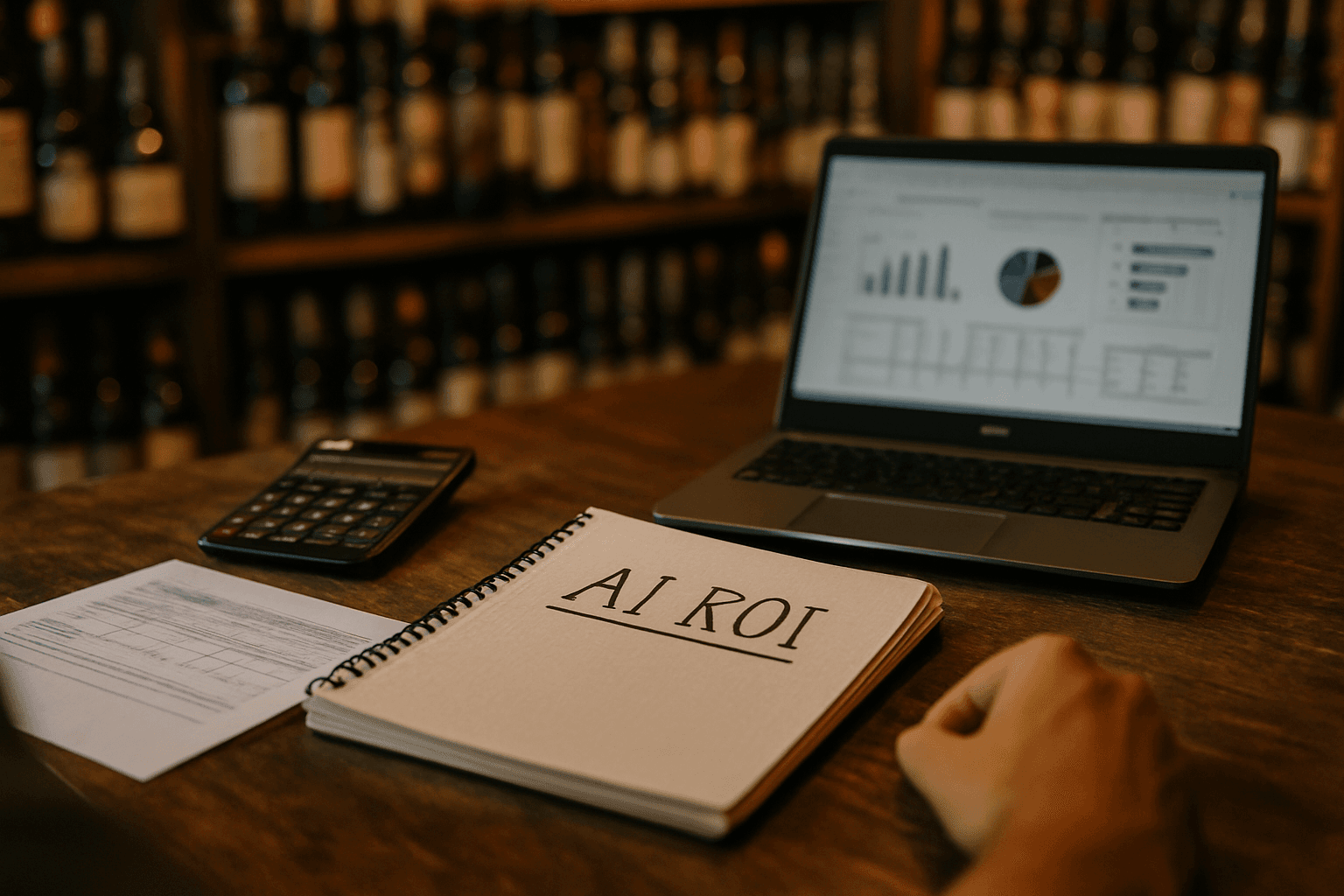
7 AI ROI Calculation Frameworks Every Small-to-Mid-Size Liquor Retailer Should Master Before Investing in Automation
By LiquorChat, Editorial Team9 min read
Listen to this article8:14
Calculate real AI ROI for your liquor store with these 7 frameworks. Stop guessing, start measuring automation value.
Before evaluating any AI vendor, write down the core ROI formula: ROI = (Net Return − Cost) ÷ Cost × 100. Microsoft Tech Community ↗ defines this as the net return from investment minus the cost of investment, divided by the cost of investment. Net Return isn't just revenue, it includes cost savings and risk reduction. Your total Cost covers software, implementation, training, and integration time.
Running this on paper before talking to salespeople exposes inflated vendor claims and sets a realistic baseline. Industry research shows most AI pilots never scale, and without a solid AI ROI framework, you'll struggle to separate hype from genuine value. One liquor retailer reduced stock overages by 18% through AI-driven inventory management, proving that proper measurement unlocks real value.
Treat these two AI types differently when calculating returns. According to Deloitte ↗, 86% of AI ROI leaders explicitly use different frameworks for generative versus agentic AI applications. Generative AI, chatbots, product recommenders, marketing copy, drives value through customer engagement and conversion rates. Agentic AI, autonomous ordering, dynamic pricing, demand forecasting, earns its keep through operational efficiency and error reduction.
If you lump both into one ROI measurement, you'll never know which technology is actually performing. Separate AI ROI frameworks give you honest clarity on where your automation dollars are working and where they need adjustment.
Before calculating percentages, map your AI investment across five dimensions: use case, phase, benefits, costs, and trust. The use case dimension asks a simple but critical question, which specific problem does this AI solve, and does it matter to your bottom line? The trust dimension is often overlooked: do your staff and customers believe in the AI's outputs? Without adoption, even the most technically sound solution delivers nothing.
Discover 7 proven AI ROI frameworks tailored for liquor retail. Learn how to measure automation value beyond cost sav...
Scoring each dimension one to ten gives you a balanced picture that a single ROI percentage never reveals. According to Deloitte, 86% of AI ROI Leaders explicitly use different frameworks for generative versus agentic AI, suggesting that one formula rarely fits all. Use case clarity and team buy-in often matter more than projected cost savings when determining whether an AI investment actually scales.
Generic AI ROI frameworks miss what makes liquor retail different, state compliance exposure, three-tier supplier complexity, and category-level margin swings that standard retail metrics ignore. Layer in liquor-specific KPIs: compliance violations avoided, supplier rebate accuracy, and category gross margin by segment. These capture value streams generic frameworks never measure.
A real-world retailer reduced stock overages by 18% while growing repeat customers using AI-driven inventory and targeted marketing (Liquorshop.ai ↗ via Medium ↗). With 80% of retail AI pilots never scaling, generic frameworks leave significant value unmeasured. Your AI ROI frameworks must account for your compliance exposure and supplier relationships, not just sell-through rates.
Before launching any AI pilot, run the Scaling Readiness Check, or risk joining the 80% of retail AI projects that never scale, according to LinkedIn research ↗. This check asks a critical question: does your solution drive value in cost reduction, customer retention, AND revenue growth, or just one? Most pilots measure only cost reduction, the narrowest ROI category. For real compounding returns, your AI ROI frameworks must articulate value across at least two categories.
Discover 7 AI pricing intelligence strategies to protect your liquor store margins before supplier price increases hi...
A liquor retailer proved this by cutting stock overages by 18% while boosting repeat customers through AI-driven inventory and targeted marketing. If your pilot can't pass this test, it won't survive past the pilot phase.
Week-one AI ROI measurements capture implementation costs and learning curves, not actual value creation. The real gains compound over months as systems learn your inventory patterns and customer behavior. Set milestone check-ins at 30, 60, 90, and 180 days, each should reveal different layers of return.
Research on retail AI pilots suggests most stall because operators judge too early. Retailers who quit at six weeks are measuring the wrong window entirely. Stick with structured AI ROI frameworks long enough to see the full picture.
Before signing any AI vendor contract, map each project to three value categories: cost efficiency, customer loyalty, and compliance/risk reduction. Many AI ROI frameworks currently in circulation lack rigor, they're essentially vibes with spreadsheets rather than structured measurement tools. A spreadsheet labeled "AI ROI" without category mapping isn't a framework; it's a hope and a prayer.
Learn how AI weather-based demand forecasting liquor retail tools auto-adjust chilled red wine merchandising before h...
Assign a dollar proxy to each category per project, even rough estimates force honest conversations about where AI actually earns its keep. The Reddit r/Entrepreneurs community ↗ reflects broader industry skepticism about vague AI ROI frameworks, many practitioners openly question whether anyone has truly cracked the measurement problem for small retail operations.
These seven frameworks give you the measurement rigor to cut through vendor hype and spot real value in your liquor store. Start with the core formula, apply liquor-specific metrics, and measure across multiple time horizons to see the full picture. The retailers who scale AI successfully aren't the ones with the biggest budgets, they're the ones who measure honestly and adjust quickly.
Ready to calculate your AI ROI? Our free AI ROI Calculator for Liquor Retailers walks you through each framework step-by-step, helping you map your investment to cost savings, customer retention, and compliance benefits. Enter your numbers once, and see exactly where automation can drive real value for your store, usually in under 15 minutes.
| Framework | Best For | Measurement Focus | Setup Effort | Time to Value |
|---|---|---|---|---|
| Core ROI Formula | Any AI investment | Financial return (%) | Low | Immediate |
| Generative vs. Agentic Split | Mixed AI tools | Type-specific value | Medium | 2–3 months |
| Five-Dimension Scorecard | Comprehensive evaluation | Holistic (cost, benefit, trust) | High | 3–6 months |
| Liquor-Specific Lens | Beverage retail only | Compliance, inventory, retention | Medium | 3–4 months |
| Scaling Readiness Check |
| Pilot programs |
| Expandability signals |
| Low |
| 1–2 months |
| Timeframe Reset | Long-term strategy | Months vs. weeks thinking | Low | 6–12 months |
| Value Category Mapping | Multi-stakeholder projects | Cost, retention, compliance | Medium | 3–5 months |