How AI Route Optimization Cuts Last-Mile Delivery Costs for Regional Beverage Distributors
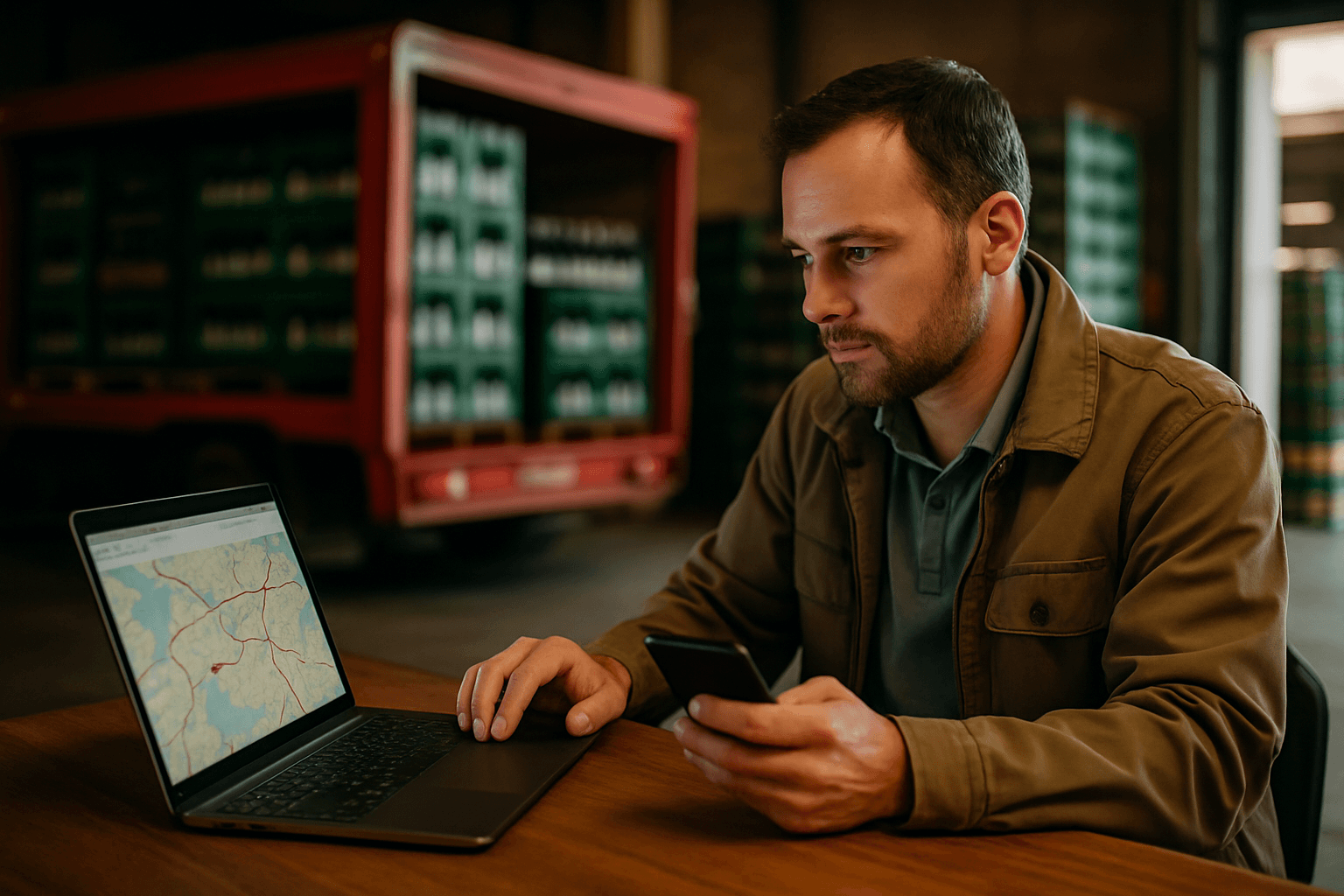
AI route optimization beverage distribution can slash last-mile costs that eat up 53% of supply chain spend. A practical guide for regional distributors.
- The 53% Problem: Why Last-Mile Delivery Is Crushing Regional Distributor Margins
- What AI Route Optimization Actually Does (Beyond Drawing Lines on a Map)
- Five Ways AI Route Optimization Directly Reduces Distribution Costs
- Beverage-Specific Constraints That Make Generic Route Software Fall Short
- From Reactive to Proactive: How Predictive Ordering Supercharges Route Efficiency
Every regional beverage distributor knows the feeling: trucks roll out at dawn, drivers navigate a gauntlet of tight delivery windows and locked back doors, and by end of day, the margin between profit and loss comes down to how many cases actually made it to the account, and at what cost. In an industry where the three-tier system adds structural complexity to every transaction, the last mile isn't just a logistics challenge. It's the single biggest line item most distributors have never truly optimized. And it's bleeding them dry.
AI route optimization for beverage distribution changes that equation, not with futuristic promises, but with practical, deployable technology that's already reshaping how the smartest regional operators plan routes, load trucks, and get product to the shelf. This isn't about replacing your drivers or your dispatch team. It's about giving them tools that account for the realities generic logistics software ignores: alcohol compliance windows, age-verification dwell time, mixed-load fragility, and the chaotic order flow that defines this industry. The distributors adopting these systems now aren't just saving money. They're building operational advantages that compound every single day.
This guide breaks down exactly how AI route optimization works in the context of beverage distribution, where the cost savings actually hit your P&L, why off-the-shelf logistics tools fall short, and how to get started, even if your current tech stack runs on spreadsheets and institutional memory. Whether you're running 15 trucks or 150, the math is the same. And it starts with one brutal number.
The 53% Problem: Why Last-Mile Delivery Is Crushing Regional Distributor Margins
Here's a number that should keep every regional distributor's CFO up at night: last-mile delivery accounts for up to 53% of total supply chain costs (Capgemini Research Institute ↗ [VERIFY: confirm original source, widely cited but often misattributed to MIT Sloan]). Run the math on a regional distributor doing $20M in annual revenue, and that final leg, getting cases from your warehouse to the account's back door, is potentially consuming $10.6 million every single year.
That's not a line item. That's half your operating budget driving around town.
Breaking Down the Real Cost of Getting Cases to the Account
Three cost drivers dominate last-mile economics: fuel, vehicle wear, and labor. And they don't just add up, they compound. When your route managers are planning 40+ stops across a metro area using spreadsheets, tribal knowledge, or route books that haven't been updated since 2019, every inefficiency multiplies across all three categories simultaneously. An extra 12 miles per route doesn't just burn diesel. It accelerates brake wear on a truck hauling 38,000 pounds. It pushes a driver into overtime. It means one fewer delivery that day.
Why Beverage Distribution Last-Mile Is Harder Than Standard Freight
Standard freight has it easy compared to alcohol distribution. Consider what makes your routes uniquely punishing:
- Weight and bulk, Liquid loads are heavy. You're maxing out truck capacity by weight long before you fill the cube, limiting drops per run.
- Regulatory delivery windows, You can't deliver alcohol whenever you want. State and local laws dictate tight time windows, compressing your available route hours.
- Age-verification dwell time, Every single stop requires a verified, authorized recipient. That's 5–10 extra minutes per delivery that Amazon's drivers never deal with.
- Failed deliveries, Bar closed for a private event. Manager called in sick. No one with signing authority on-site. An entire route segment, fuel, time, labor, wasted with zero revenue to show for it.
This is exactly why AI route optimization isn't a nice-to-have technology experiment for beverage distributors. It's the single highest-ROI investment a regional distributor can make right now, and the distributors who move first will build a structural cost advantage that manual-route competitors simply cannot match.
What AI Route Optimization Actually Does (Beyond Drawing Lines on a Map)
Let's cut through the noise. AI route optimization for beverage distribution isn't just a prettier version of Google Maps for your fleet. It's software that ingests historical delivery data, real-time traffic feeds, account-level constraints, delivery windows, dock availability, order size, even whether a location requires age verification at a specific entrance, and vehicle capacity to generate the most efficient route sequence. Then it continuously adjusts as conditions change throughout the day.
That last part is what separates AI from everything your team has been doing until now.
From Static Route Sheets to Dynamic, Constraint-Aware Planning
Be honest: how are your routes built today? If you're like most regional distributors, the answer is some combination of driver tribal knowledge, static route books updated quarterly (maybe), and basic GPS routing that has zero awareness of load weight, compliance windows, or account priority.
Your veteran driver knows that Murphy's Liquor Barn needs delivery before 10 AM and that the loading dock at Costco is a nightmare after noon. That's valuable, until he retires, calls in sick, or you're onboarding three new drivers simultaneously. Tribal knowledge doesn't scale. It doesn't adapt when a winter storm reroutes I-70 at 6:45 AM.
When over half your supply chain costs live in the last mile, you can't afford to manage it with a laminated route sheet and a prayer.
Discover 8 AI route optimization tactics to cut last-mile costs, streamline delivery routes, and boost efficiency for...
The Three AI Layers: Predictive Analytics, Real-Time Optimization, and Automated Load Planning
Modern AI-powered delivery logistics in the beverage industry operate across three distinct layers working in concert:
- Predictive analytics forecast which accounts will order and when, based on historical purchase patterns, seasonality, and even local events, so you're planning capacity before the PO hits.
- Real-time route optimization factors in alcohol-specific constraints: regulatory delivery windows, age-verification requirements, account priority tiers, and live traffic. Routes adjust mid-day based on cancellations, add-on orders, and road conditions.
- Automated load planning sequences truck packing to match delivery order, so your last stop's two cases of allocated bourbon aren't buried behind the first stop's 40-case pallet of domestic lager.
This isn't experimental technology. The global AI in warehousing and logistics market is valued at $5.4 billion in 2025 and projected to reach $25.1 billion by 2034 at a 17.3% CAGR [VERIFY: cite specific market research source]. Platforms like MaxOptra already serve over 450 customers, and its January 2025 acquisition by The Access Group signals accelerating enterprise demand [VERIFY: confirm acquisition date and customer count].
The real unlock? AI-integrated ERP systems now enable continuous optimization, not a one-time morning route plan that's obsolete by 9:30 AM. Last-mile cost reduction becomes an ongoing process, not a quarterly project.
Under the hood, this is where concepts like tool orchestration and retrieval-augmented generation (RAG) matter. The AI doesn't just run a static algorithm, it retrieves real-time data from your ERP, TMS, and traffic APIs, reasons across constraints, and orchestrates multiple specialized models (demand forecasting, geospatial routing, load physics) to produce a unified plan. This multi-agent architecture is what makes the system adaptive rather than brittle.
Five Ways AI Route Optimization Directly Reduces Distribution Costs
When more than half your supply chain spend lives in the last mile, even marginal efficiency gains compound fast. Here's where AI route optimization hits your P&L hardest.
Fuel and Fleet Savings That Show Up on the P&L
Cost Lever #1, Fuel reduction. AI eliminates redundant miles by sequencing stops optimally and rerouting around real-time traffic, construction, and road closures. Run the math: a 30-truck fleet averaging 150 miles per day at $4.00/gallon diesel and 7 MPG burns roughly $7,700 daily. A 15% mileage reduction, conservative for most legacy-routed fleets, saves over $1,100 per day, or north of $25,000 monthly. That's not a projection. That's diesel you don't burn.
Cost Lever #2, Vehicle wear and maintenance. Fewer miles is obvious. What's less obvious: AI can factor in road conditions, turn complexity, and elevation changes to reduce hard braking and stop-and-go cycling. Fewer mechanical stress events extend brake, tire, and transmission life, and reduce the unplanned maintenance pulls that leave you scrambling to cover routes with backup vehicles. For fleets running heavy-loaded beverage trucks, this is real money.
Labor Efficiency: Fewer Hours, More Drops
Cost Lever #3, Labor optimization. When routes are sequenced by delivery window, load order (last on, first off), and geographic clustering, drivers complete more stops per shift. The same team covers more accounts without overtime. In an industry where driver labor is your single largest controllable expense, this is the highest-leverage application of route intelligence.
Cutting Failed Deliveries and Reverse Logistics Waste
Cost Lever #4, Failed delivery reduction. AI predicts receiving issues from historical patterns, "This bar never has someone at the dock before 11 AM on Mondays", and schedules accordingly. Every avoided failed delivery saves the fully loaded cost of a return trip: fuel, labor, vehicle time, and the cascading disruption to remaining stops.
Cost Lever #5, Forward Stocking Locations (FSLs). AI analytics identify when establishing smaller warehouses closer to dense urban delivery zones would reduce total last-mile costs. Combined with strategies like efficient load sizing, smart return management, and local consolidation points, these decisions become data-justified rather than gut-driven, turning route optimization into a strategic planning tool, not just a daily dispatch feature.
Beverage-Specific Constraints That Make Generic Route Software Fall Short
Alcohol delivery isn't like dropping off Amazon packages. And yet, too many regional distributors are still trying to force-fit generic logistics tools into a workflow those tools were never designed to handle.
As NextBillion.ai research highlights, beverage distributors face a unique intersection of regulatory, physical, and operational constraints that make purpose-built optimization solutions dramatically more valuable than off-the-shelf alternatives.
Discover 7 route optimization triggers that liquor distributors should automate using AI to cut costs and boost deliv...
Alcohol Compliance and Delivery Window Regulations
State and local regulations dictate when alcohol can be delivered, who can receive it, and what documentation is required at every single stop. Generic route software doesn't model these constraints natively, it wasn't built for a three-tier system where a restaurant needs product before 11 AM service, a retailer only accepts during a four-hour receiving window, and a chain account enforces rigid 15-minute appointment slots.
Purpose-built AI optimizes across hundreds of these windows simultaneously, something no human dispatcher can do manually at scale. It also accounts for age-verification dwell time: every stop requires ID check and signature capture. Using generic stop-time averages instead of alcohol-specific dwell times produces inaccurate ETAs that cascade into missed windows and rejected deliveries across an entire route.
Weight, Fragility, and Mixed-Load Complexity
A pallet of bourbon weighs dramatically different from a pallet of hard seltzer. Effective AI route optimization for beverage distribution factors axle weight limits, vehicle capacity by both weight and volume, and mixed-load stability into every route plan. A case of glass bottles stacked under kegs isn't just inefficient, it's a breakage claim waiting to happen.
This is where last-mile cost reduction gets real: when your route software understands that a 26-stop mixed route through downtown requires a different vehicle configuration than a 12-stop spirits-heavy suburban run, you stop burning money on redeliveries, damage claims, and compliance violations.
From Reactive to Proactive: How Predictive Ordering Supercharges Route Efficiency
Here's the dirty secret of beverage distribution logistics: most route inefficiency isn't a routing problem, it's an ordering problem.
When orders trickle in via phone, fax, and portal right up until the morning cutoff, your dispatch team is replanning routes at 5 AM with incomplete information. That reactive chaos is where last-mile savings die on the vine.
The NBWA has noted a clear shift: a growing number of beverage distributors are moving from reactive order processing to proactive, AI-powered predictive ordering. This is where route optimization gets genuinely transformative.
Using Internal Data to Anticipate Demand Before the Phone Rings
Predictive ordering AI analyzes what you already have, historical order patterns, account-level depletion rates, seasonality curves, local event calendars, even weather data, to forecast what each account will need and when. Often before the buyer picks up the phone.
This isn't guesswork. It's pattern recognition across thousands of transactions, running continuously.
How Predictive Orders Create Denser, More Efficient Routes
When you can predict Tuesday's orders on Friday, everything changes. Consider a 200-account regional distributor: predictive ordering can shift operations from daily 5 AM route scrambles to having 80% of next week's routes locked by Thursday. Warehouse teams stage loads in delivery sequence. Drivers review stops in advance. Trucks roll out denser and smarter.
This is agentic AI in action, and it's worth understanding the architecture because it explains why these systems get smarter over time. Predictive ordering agents feed route optimization agents, which feed load-planning agents. Each agent is a specialized reasoning model with access to specific tools (your ERP, weather APIs, traffic feeds) orchestrated through a multi-agent swarm architecture. The ordering agent uses RAG (retrieval-augmented generation) to pull account history and depletion data from your systems in real time, then reasons about likely orders. The routing agent ingests those predictions alongside live constraints and generates optimized sequences. The load-planning agent translates route order into physical truck configuration.
No single model could do all of this well. The orchestration layer, what LiquorChat builds around, coordinates these specialized agents so each component makes the others more intelligent. That's the difference between a tool and a system.
Discover how AI route optimization is transforming last-mile delivery for mid-size beverage distributors, cutting cos...
Getting Started: A Practical Roadmap for Regional Distributors
You don't need to rip and replace your tech stack. Modern AI route optimization tools layer on top of your existing ERP and WMS via API. Here's how to start.
Phase 1: Audit Your Current Route Costs and Inefficiencies
Calculate your true last-mile cost per case delivered. Include fuel, driver labor, vehicle depreciation, overtime, and failed delivery costs. Most distributors have never isolated this number, and they're shocked when they do. Even small inefficiencies compound fast across hundreds of daily stops.
Phase 2: Evaluate AI Route Optimization Platforms
Look for platforms built for beverage distribution constraints: alcohol compliance delivery windows, weight-based load optimization, ERP integration, and real-time rerouting. The market is maturing quickly, MaxOptra serves 450+ customers and was acquired by The Access Group in January 2025 [VERIFY], signaling strong demand and consolidation in this space.
Key evaluation criteria:
- Does the platform model alcohol-specific regulatory windows natively?
- Can it optimize by both weight and cube simultaneously?
- Does it integrate with your ERP/WMS via API without requiring a full migration?
- Does it support real-time rerouting, or only static morning plans?
Phase 3: Pilot, Measure, and Scale
Pilot 5–10 routes for 60 days. Track miles per stop, stops per driver-hour, fuel cost per delivery, and failed delivery rate against your pre-AI baseline. These are your proof points. Scale what works, route group by route group.
Quick Help Guide: 3 Things You Can Do This Week to Cut Last-Mile Costs
No software required. These are wins you can capture before Friday.
For Distributors: The 60-Second Route Density Check
Tactic #1 (30 seconds): Pull last month's delivery data and map every stop. Look for routes crisscrossing the same zip code on different days, that's your lowest-hanging consolidation opportunity. AI automates this analysis continuously, but you can spot the worst offenders manually right now.
Tactic #2 (60 seconds): Call your five highest-failed-delivery accounts. Confirm actual receiving windows and contact info. Update your system immediately. Failed deliveries are the single most expensive last-mile inefficiency, and bad data is almost always the root cause.
For Producers and Brand Managers: How to Support Your Distribution Partners
Tactic #1 (30 seconds): Ask your distributor rep what their delivery constraints look like for your key accounts. If you're pushing promotions that spike orders in zones with tight delivery windows, you're creating route chaos, not growth. Coordinate promo timing with distribution capacity. Your depletion numbers actually improve when product arrives on time.
Tactic #2 (60 seconds): Review your next planned promotion and check whether the volume spike falls on your distributor's heaviest delivery days. Shifting a promo launch by even one day can mean the difference between on-time placement and a week of backlogged deliveries that tank your velocity data.
The Bottom Line: Optimize the Last Mile or Subsidize It
The math isn't ambiguous. When last-mile delivery consumes over half your total supply chain costs, every unoptimized route is a direct subsidy to inefficiency, paid for out of your margin. The technology to fix this exists today. It's proven, it's deployable on top of your current systems, and it's purpose-built for the constraints that make beverage distribution fundamentally different from every other logistics vertical.
AI route optimization for beverage distribution isn't coming. It's here. Regional distributors who implement it now will compound cost advantages month over month, denser routes, fewer failed deliveries, lower fuel burn, less overtime, smarter load plans. Those who wait will watch their per-case delivery costs climb while competitors with optimized fleets take share on service reliability alone.
You don't need to overhaul everything at once. Start with the baseline: know your true cost per case delivered. Identify your worst-performing routes. Clean up your failed delivery data. Then pilot, measure, and scale. The roadmap is clear, the quick wins are immediate, and the long-term structural advantage is real.
AI route optimization is one piece of the puzzle. LiquorChat ↗ helps every tier of the alc-bev industry work smarter with AI, from the delivery truck to the shelf to the depletion report. If you're ready to stop subsidizing last-mile chaos and start building a cost structure your competitors can't match, start the conversation with LiquorChat today ↗.